Catalog awareness on AWS Bedrock: pick-your-model, IRSA, and a chat UI
Taking catalog-assistant from one hard-coded model to any Bedrock LLM — operator-chosen, role-authenticated on EKS, and cheap enough to run per question.
backstageaillmawsbedrockclaudeekstypescript
Part 3 built the load-bearing core of
catalog-assistant: grounded natural-language Q&A over the Backstage
Software Catalog, with retrieval over real entities and entity-ref
citations. It was deliberately minimal — one model, no conversation
memory, no UI. Just enough to prove the grounding works.
This post is about the part that decides whether anyone actually runs it inside a company: which LLM, authenticated how, at what cost. Most enterprises that would deploy an internal developer portal are on AWS and want their model calls to stay inside their account. So the answer is Amazon Bedrock — but Bedrock the way an operator actually wants it: the model is their choice, auth is an IAM role (no long-lived keys), and the per-question cost is low enough that “call an LLM for every catalog question” isn’t a budget conversation.
The plugin is public at
Naga15/platformlog-plugins
(@theplatformlog/catalog-assistant-backend). Here’s what changed.
One provider switch, any model
The Q&A pipeline never talks to a model SDK directly — it goes through the
Vercel AI SDK’s generateText, and a tiny resolver picks the provider.
Adding Bedrock was a single entry in a map plus a branch for how it
authenticates:
export const SUPPORTED_PROVIDERS = {
  anthropic: { pkg: '@ai-sdk/anthropic', factory: 'createAnthropic' },
  openai:    { pkg: '@ai-sdk/openai',    factory: 'createOpenAI' },
  google:    { pkg: '@ai-sdk/google',    factory: 'createGoogleGenerativeAI' },
  mistral:   { pkg: '@ai-sdk/mistral',   factory: 'createMistral' },
  bedrock:   { pkg: '@ai-sdk/amazon-bedrock', factory: 'createAmazonBedrock' },
};
The resolver dynamically imports only the provider that’s configured, so a backend that runs Bedrock never pulls in the others. Switching providers is a config change, not a code change — which matters, because the same plugin needs to run on a developer’s laptop (free, local) and in a company’s EKS cluster (Bedrock) without a rebuild.
Auth on EKS: an IAM role, not a key
The thing I care most about for production: no static credentials in
config. On EKS that means IRSA (IAM Roles for Service Accounts) or the
newer Pod Identity — the pod assumes a role, and the AWS SDK resolves it
from the environment. The Bedrock provider doesn’t bundle the AWS credential
resolver (deliberately — it keeps the package lean), so the plugin supplies
it from the optional @aws-sdk/credential-providers peer dependency when no
static keys are present:
// no static keys → resolve the role from the environment (IRSA / Pod Identity)
const { fromNodeProviderChain } = await import('@aws-sdk/credential-providers');
factoryOpts.credentialProvider = fromNodeProviderChain();
The config in the cluster carries no secret at all:
catalogAssistant:
  provider: bedrock
  awsRegion: us-east-1
  model: us.amazon.nova-lite-v1:0
Attach an IAM role allowing bedrock:InvokeModel (and
...WithResponseStream) on the model and inference-profile ARNs to the
backend’s ServiceAccount, and you’re done — the key never exists. For quick
validation without IAM, a short-lived Bedrock API key (bearer token)
also works via apiKey / AWS_BEARER_TOKEN_BEDROCK.
Two gotchas worth your time
- Model IDs are inference profiles, not the bare name. For current
Claude/Nova models Bedrock routes through a cross-region inference profile,
so the value is
us.amazon.nova-lite-v1:0, notamazon.nova-lite-v1:0. Copy the exact id from the console after enabling Model access. - Pin the AI-SDK generation. The
@ai-sdk/*provider packages move in lockstep with theaicore — mixing a provider that implements a newer model spec with an older core throwsUnsupported model version. Keep@ai-sdk/amazon-bedrockon the same major line as your other@ai-sdk/*providers andai.
There was also a bug I only found by running it: the router was reading a
token off BackstageCredentials that doesn’t exist, so the catalog read
401’d. The fix is to read the catalog as the plugin’s own service
identity — getPluginRequestToken({ onBehalfOf: getOwnServiceCredentials(), targetPluginId: 'catalog' }) — which works for any caller. Unit tests are
green and the thing looks done right up until a real backend hands you a
real credential.
Let the operator pick the model — and cap the bill
Different questions deserve different models, and operators want to disable the ones they don’t trust after a week of testing. So the model is an allowlist in config: a default plus the set offered to callers.
catalogAssistant:
  provider: bedrock
  awsRegion: us-east-1
  model: us.amazon.nova-lite-v1:0       # default
  models:
    - { id: us.amazon.nova-lite-v1:0, label: Nova Lite (cheap, default) }
    - { id: us.anthropic.claude-haiku-4-5-v1:0, label: Claude Haiku 4.5 (quality) }
That backs a GET /v1/models endpoint (which a UI dropdown reads) and an
optional model field on each query, validated against the enabled set — a
model that isn’t listed gets a 400, so nobody can quietly route traffic to
an expensive model.
What “cheap” means here
The job is grounded Q&A over a small provided context — read the entities, answer, cite. That rewards instruction-following, not raw world knowledge, so a small model is usually plenty. Bedrock has no free tier, but for this workload the cost is rounding error:
| Model | $/1M in | $/1M out | ~ $/query | Fit |
|---|---|---|---|---|
| Amazon Nova Micro | $0.035 | $0.14 | ~$0.0001 | simple lookups |
| Amazon Nova Lite | $0.06 | $0.24 | ~$0.0002 | default — strong on grounded tasks |
| Meta Llama 3.3 70B | $0.72 | $0.72 | — | good reasoning, pricier, less grounded |
| Claude Haiku 4.5 | $1 | $5 | ~$0.0035 | quality — best citation fidelity |
A typical query is ~2K grounded input + ~300 output tokens. That’s roughly 5,000 questions per dollar on Nova Lite, ~285 on Haiku. My default is Nova Lite, with Haiku in the dropdown for the hard, compound questions where staying strictly grounded matters. (Prompt caching knocks ~90% off the repeated system prompt; skip Batch — it’s async, wrong fit for interactive Q&A.)
Make it a conversation
Part 3’s biggest limitation was that every question stood alone — ask “who
owns it?” and the model had no idea what “it” was. The fix keeps the backend
stateless: the client carries the conversation and sends prior turns as
history on each request. The backend threads them before the grounded
current turn, and — the part that actually makes follow-ups work — folds the
recent user turns into the retrieval query, so “who owns it?” still
retrieves the entity named a turn ago.
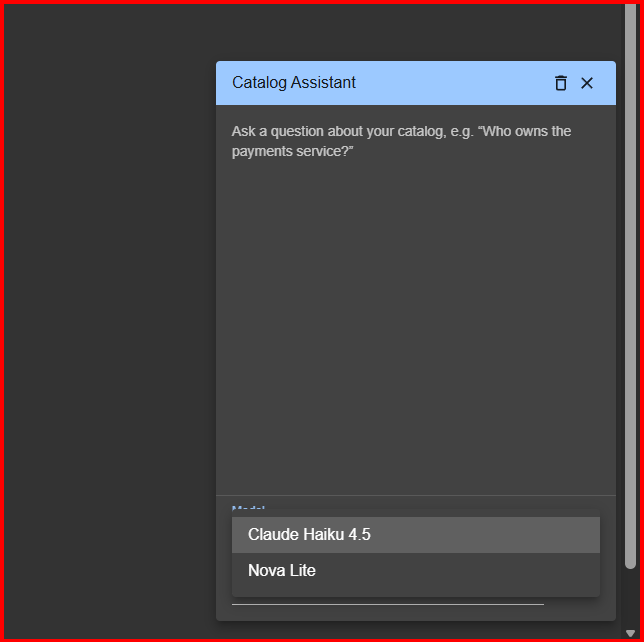
On the frontend that’s a floating chat widget (a separate package — Backstage
keeps frontend and backend as separate plugins) pinned bottom-right on every
page: a prompt box, the model dropdown wired to /v1/models, citation chips
under each answer, and a Clear button. The conversation persists for the
browser session and resets when you clear it.
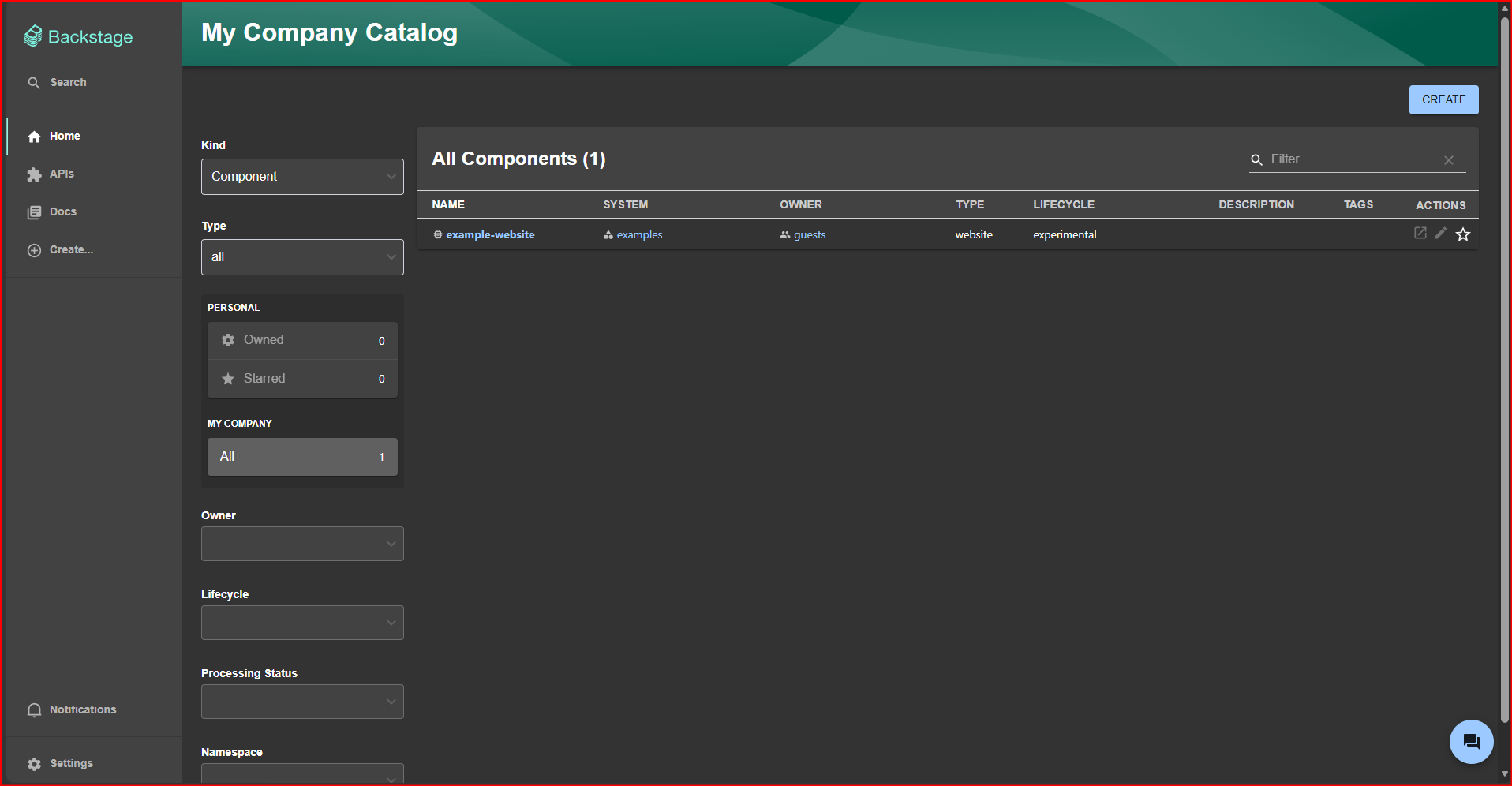
The same widget in context — the bubble sits bottom-right on every page:
Proving it without an AWS bill
The nicest property of the provider abstraction is that you can validate the
entire flow for free before pointing it at Bedrock. The openai provider
takes a baseURL, so a local Ollama endpoint stands in for the cloud at
$0:
catalogAssistant:
  provider: openai
  baseURL: http://localhost:11434/v1
  apiKey: ollama
  model: gemma3:4b
I ran the whole thing this way in a legacy Backstage app against
gemma3:4b, and confirmed end to end:
- “Who owns example-website?” → “guests”, cited
component:default/example-website. - “who owns it?” with history → resolved “it” to the prior entity.
- Switching the dropdown to a second model routed there; a disallowed model
returned
400.
Flipping that to production is the config block from the top of this post —
provider: bedrock, a region, an IRSA role, and the model list. Same plugin,
no code change. That’s the whole point: catalog awareness shouldn’t care
whether the model lives on your laptop or in your AWS account.
Pricing and model-quality figures are list prices and public benchmarks as of writing — verify current Bedrock pricing in the AWS console. Comparative figures drawn from AWS Bedrock pricing, Artificial Analysis, the Vellum LLM leaderboard, and Amazon’s Nova technical report.